Climate Control & Environment
The invisible infrastructure defining the lifespan of delicate and valuable materials.
The Importance of Environmental Stability
Artworks are deeply responsive to the atmosphere around them. Paintings on canvas, wooden sculptures, textiles, and works on paper continuously exchange moisture with their environment. In uncontrolled settings, this exchange results in expansion and contraction, ultimately leading to flaking paint, warped panels, and structural failure. The primary goal of any professional art storage facility is not simply achieving a specific temperature, but ensuring extreme environmental consistency.
Abrupt fluctuations are often more damaging than a stable but slightly imperfect baseline. Rapid shifts cause distinct material layers—such as the canvas support, the gesso ground, and the oil paint layer—to expand at different rates, resulting in cracking and separation. European storage facilities utilize advanced HVAC systems engineered specifically to smooth out these fluctuations.
Temperature and Relative Humidity (RH)
While precise requirements vary based on the specific composition of an object, general museum standards provide a baseline for storage environments. However, these are contextual guidelines rather than universal laws.
Temperature Considerations
Temperature affects the rate of chemical deterioration. Higher temperatures accelerate degradation in organic materials, while extremely cold temperatures can cause certain paints and adhesives to become brittle. A consistent temperature, typically maintained in a moderate range, ensures that materials remain stable and flexible. Furthermore, temperature directly influences relative humidity; as air warms, its capacity to hold moisture increases.
Relative Humidity (RH) Dynamics
Relative humidity is perhaps the most critical factor in collection care. If the air is too dry, organic materials like wood, paper, and parchment can desiccate, embrittle, and split. Conversely, if humidity rises too high, the environment becomes highly conducive to mold growth and biological activity, which can devastate a collection within days.
Proper facilities do not rely on standard commercial air conditioning, which often dehumidifies inconsistently. Instead, specialized desiccant dehumidifiers and ultrasonic humidifiers work in tandem to maintain a rigid RH band, typically around the median acceptable range for mixed collections, though specific zones may be tailored for hyper-sensitive materials.
Monitoring and Data Logging
A climate control system is only as reliable as its monitoring network. State-of-the-art European facilities employ redundant environmental tracking protocols.
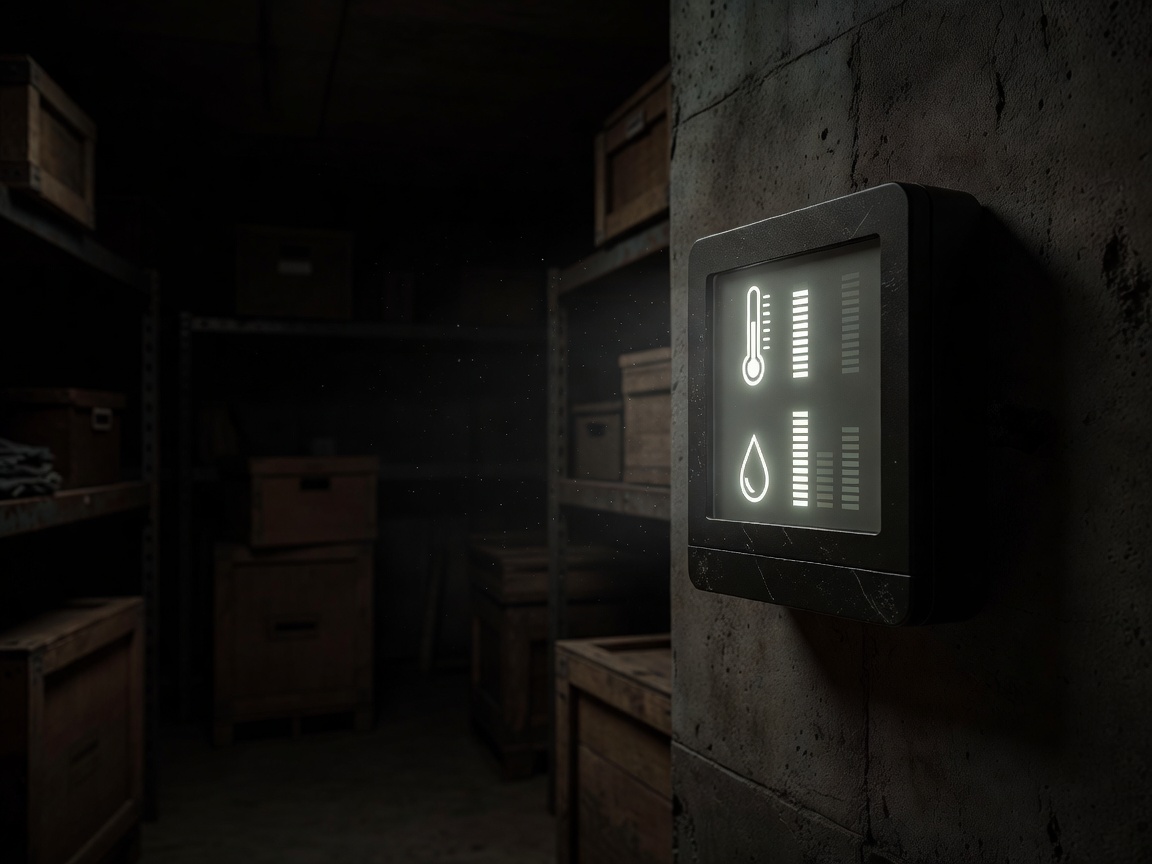
- Continuous Datalogging: Digital sensors record temperature and RH continuously, providing granular data that can be audited over weeks, months, or years.
- Zonal Tracking: Large vaults are monitored across multiple physical zones to ensure micro-climates or "dead spots" with poor air circulation do not develop.
- Automated Alerts: Systems are designed to trigger alarms if parameters drift beyond acceptable tolerances, allowing technicians to address HVAC anomalies before the artwork is compromised.
Air Quality and Light Exposure
Beyond thermal and moisture regulation, the purity of the air and the absence of light are critical storage components.
Air Filtration: Particulate matter, dust, and gaseous pollutants (such as ozone or sulfur dioxide from urban environments) can settle on artwork surfaces, leading to staining and chemical reactions. Archival storage areas utilize HEPA filtration and activated carbon systems to scrub the air of both physical dust and harmful chemical vapors.
Light Control: Light damage is cumulative and irreversible. Exposure to ultraviolet (UV) and intense visible light causes pigments to fade and cellulosic materials (like paper) to yellow and weaken. Dedicated storage environments are kept dark when not in use. When illumination is necessary for inspection or movement, facilities utilize low-heat, UV-filtered LED lighting on strict motion timers.
Understanding Handling Requirements
A stable climate is just one aspect of collection care. Proper handling ensures works are moved without compromising their condition.
Review Art Handling Guidelines